


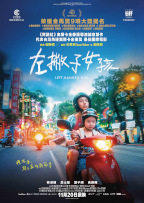
Zuopiezi nühai
Taiwan 2025
Genre:
Drama
Director:
Tsou Shih-Ching
Cast:
Janel Tsai
Ma Shih-Yuan
Nina Ye
Brando Huang
Akio Chen
Xin-Yan Chao

Left-Handed Girl
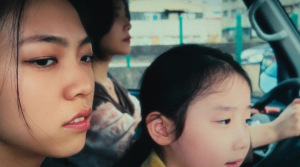
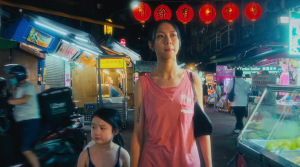
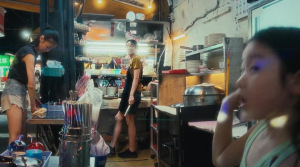
Story: Nine-year-old I-Jing (Nina Ye) returns to Taipei with her mother, Shu-Fen (Janel Tsai), and older sister, I-Ann (Ma Shih-Yuan). Her mother opens a small food stall at a night market to make ends meet. I-Ann also works and believes she can earn more money than her mother. She has a casual relationship with her boss, while Shu-Fen learns that her ex-husband is dying. Despite him abandoning the family several years ago, she visits him in the hospital, much to her daughter's dismay. I-Jing occasionally helps her mother with her work as well. When she visits her grandparents, her grandfather scolds her for being left-handed. He tells her it's the devil's hand. I-Jing takes this at face value, and when she starts stealing small items at the night market, she believes her devil's hand is to blame, not her. Meanwhile, Shu-Fen is struggling financially, as she's having trouble paying the rent for her stall. Johnny (Brando Huang), who also has a stall at the market, wants to help her out, but she refuses. Nevertheless, the two grow a little closer, while I-Ann mainly takes care of little I-Jing.

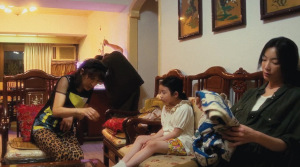
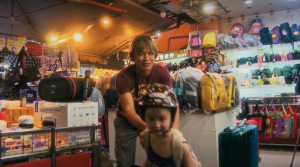
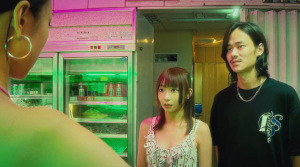
Review: "Left-Handed Girl" is a film that, on paper, looks like it was made for film festivalgoers who celebrate extremely slow-paced dramas to reassure themselves of their own superior cinematic taste. We have a dysfunctional family, starting with an overwhelmed mother and ending with the young daughter who steals because the evil hand of the devil commands her to. What's more, the film was shot entirely with an iPhone — a shaky handheld camera is practically mandatory if you want to win awards at a film festival. But even though "Left-Handed Girl" throws us into the lives of this family as observers, even by showing us everyday life through the eyes of little I-Jing in the beginning, this drama doesn't feel like an art-house film at all. This might be mainly due to the brisk pacing and editing, but it's also thanks to the subtle and very natural humor.
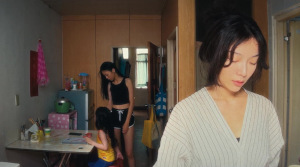
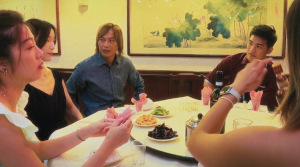
It should also be mentioned that the film doesn't attempt to do without dialogue. While the mother herself might not be the most talkative person, there are plenty of other family members who aren't afraid to speak their minds. For example, there's the daughter, about whom one isn't sure to what extent she might be prostituting herself in her job — an impression that others share, as will become clear. Yet she possesses immense pride, as revealed in the way she treats her dying father. Furthermore, she cares for her little sister with remarkable devotion, making her arguably the most interesting character in the film. She embodies several contradictions, which nevertheless blend together with complete authenticity. The same can be said of all the other characters. Even Johnny has more quirks and flaws than one would expect from a supporting role as the mother's potential new boyfriend.
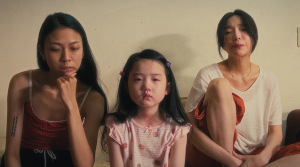
What surprised me most, however, was how engaged I was with the events unfolding on screen. There is always something happening. Whether it's the grandmother's identity fraud, as she constantly flies abroad on behalf of and with others, or the young daughter who takes her grandfather's words seriously and now believes her hand is evil. The latter also exemplifies the clash of generations. The grandmother wants to bequeath her apartment to her only son, even though it had already been agreed that it would be divided among the children. The daughters are no longer considered their mother's responsibility once they are married, and so on. This traditional way of thinking, which doesn't easily disappear from people's minds even in modern Taiwan, provides another layer, alongside the individual stories, on which the narrative can spark interest. Furthermore, it certainly doesn't hurt that the family's very survival is constantly at stake.
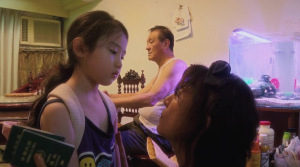
Female director Tsou Shih-Ching skillfully maintains a close connection to her characters. Taiwanese dramas like "The Falls" have already demonstrated that art-house stories can be brought to the screen without their associated coldness, but Tsou succeeds even better at forging a strong emotional bond between the viewer and the characters. Additionally, the dialogue feels very authentic and subtly conveys situational humor, which makes the characters even more charismatic. This is all the more remarkable given that the entire family portrayed (and not only that one) possesses some less than flattering character traits. But each of these flaws is somehow understandable, be it the mother who cares for her ex-husband even though he left her with a mountain of debt years ago, or the daughter who cannot forgive her father and has a very cold and heartless scene with him in the hospital. Although there are some tragic scenes, "Left-Handed Girl" is generally permeated by a pleasant warmth.
A little criticism is warranted regarding the finale, in which all the threads come together perhaps a bit too conveniently, resulting in a theatrical climax that, while entertaining, also contrasts with the otherwise authentic tone of the story. Moreover, we get a surprising twist, which, admittedly, was hinted at throughout; at least in retrospect, some of the clues become apparent - which is quite nice. Above all, this approach reinforces the film's central theme: we gain insight into the life of a family that, at first glance, might even be considered "antisocial". But the truth is far more complex, and the characters are genuinely endearing in their own way. "Left-Handed Girl" is a drama that offers the necessary warmth, a good pace, pleasant humor, and very well-written characters, so I never found myself wondering when the credits would finally roll — quite the opposite, in fact.





Disclaimer
