


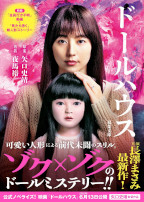
Dollhouse
Japan 2025
Genre:
Horror, Drama
Director:
Shinobu Yaguchi
Cast:
Masami Nagasawa
Koji Seto
Aoi Ikemura
Tetsushi Tanaka
Ken Yasuda
Jun Fubuki
Totoka Honda

Dollhouse
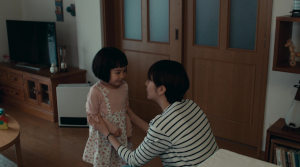
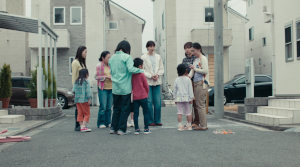
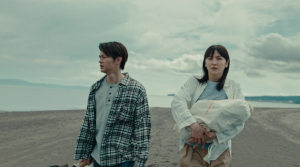
Story: Yoshie (Masami Nagasawa) and Tadahiko (Koji Seto) are married and have a young daughter named Mei (Totoka Honda). While Mei is playing hide-and-seek with the neighborhood children at Yoshie's house, her mother goes shopping. When she returns, however, no one is home. The neighborhood children are back with their parents, and no one knows where Mei is, as she wasn't found during the game. A missing person report is filed, until Mei's body is eventually discovered. Yoshie is devastated, takes painkillers, and attends a support group. Nevertheless, nothing seems to help her. Then one day, she finds an antique doll at a flea market. She treats it like her own daughter, and despite his misgivings, Tadahiko allows her to continue treating the doll like a person, as the doctors assure him that this could actually help his wife. A short time later, Yoshie becomes pregnant and little Mai is born. The mother recovers and banishes the doll to the closet. Five years later, Mai (Aoi Ikemura) finds the doll and wants to play with it. Soon the two are inseparable, and Mai claims the doll's name is Aya and that she talks to her. Yoshie initially thinks nothing of it until she experiences strange occurrences in the house, which slowly lead her to believe the doll has developed a life of its own. Her husband, though, suspects his wife has suffered another relapse.

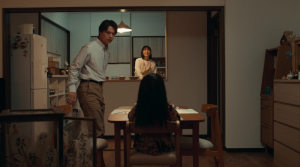
Review: I'm putting it very mildly when I say I was quite surprised to read that Shinobu Yaguchi was the man behind the camera. The director is usually known for very lively comedies like the fantastic "Swing Girls" or, from six years ago, "Dance with Me". Here we have a genuine horror film, which places great emphasis on drama and creepy scenes and is therefore not comparable to modern examples of the genre with their countless cheap jump scares. Rather, it's reminiscent of classics like Hideo Nakata's "Ring". Ultimately, the film can't avoid using a few genre clichés, but the way the story takes its time to build momentum is very enjoyable. This gives the characters room to become established in the story and build a solid foundation for what's to come, ensuring that the inevitable developments, including the search for the truth and the background surrounding the doll, aren't a matter of indifference or merely a means to an end for a few jump scares. The drama at the beginning, in particular, can be surprisingly gripping.
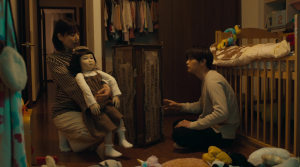
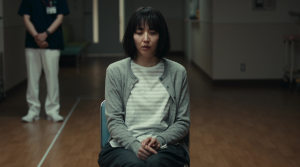
Masami Nagasawa ("The Parades") deserves particular praise for conveying Yoshie's trauma of losing her daughter with surprising depth. She is also the reason why Koji Seto's portrayal of the husband seems rather flat, a fact that becomes especially noticeable towards the end when he moves further into the foreground. As is common for characters in horror films, the husband merely serves as a cog in the machine, keeping the story moving. Fortunately, the film primarily focuses on the relationship between Yoshie and Mai. However, there are a few scenes that can send shivers down your spine. We repeatedly catch glimpses of a child rushing past, only to then see Mai somewhere else entirely. Clearly, this is a deliberate trope, suggesting the doll might have a life of its own, but some of these scenes are repeated a bit too often, especially since the viewer is obviously aware from the get-go that it's a doll possessed by an evil spirit. The genre isn't reinvented here after all. Nonetheless, as already mentioned, it's refreshing that unnecessary jump scares supported by a steady increase of the soundtrack's volume are largely avoided.
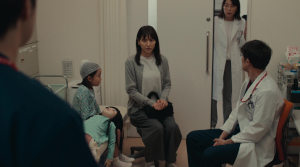
The horror, instead, is presented in a far more subtle way, embellished towards the end with a few pleasant surprises and, above all, some Buddhist elements, including a few rituals. Still, one has to question whether the subplot with the policeman Yamamoto was truly necessary. Tetsushi Tanaka (also seen in "The Parades") as a monk carries the story forward meaningfully, even if one can't help but chuckle at the somewhat clumsy ways in which the couple remains at the center of the narrative. It starts with the couple suddenly becoming incredibly curious and then involves a clumsy mistake by the monk for them to remain the ones having to deal with the situation. Nevertheless, director and screenwriter Shinobu Yaguchi manages to keep his story moving and the viewer engaged. The finale holds a few more twists and turns, even when you think everything has been resolved. Somehow, though, one can't help but feel that this is precisely the typical formula of a horror film. When the final scene of "Dollhouse" flickers across the screen, you'll know what I mean.
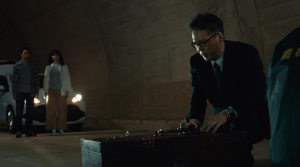
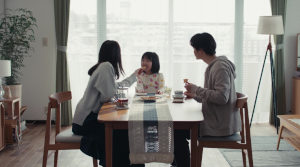
Technically, there's nothing to criticize here. The director knows how to create a sense of dread without resorting to darkness and gloom. Some of the scenes in the light-filled apartment are particularly convincing. Photography and video are also used to instill a sense of fear. "Dollhouse" doesn't bombard us with nightmarish imagery, but when it does, it's quite effective. Some scenes, as well as the doll's true face, could easily have come across as ridiculous in the hands of a less skilled director. Shinobu Yaguchi, however, knows how to use light and shadow to his advantage and gets the most out of the makeup effects. He also succeeds brilliantly in building atmosphere, which is absolutely crucial for a film in this genre. The opening scene alone creates unease and inner tension as the children play while Yoshie is out shopping. The revelation of how the daughter died is so effectively executed that Yoshie's descent into madness is all too understandable.
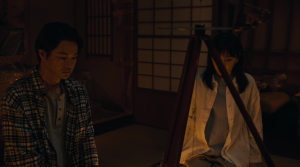
Despite some very gripping scenes – the rituals reminiscent of shamanistic traditions are undoubtedly well done – it must be noted that the shift in focus in the second half, from the mother to the father, or rather to both, is not very convincing. Yoshie is the heart of the story, and even though the director becomes aware of this again towards the end and manages to steer the film a bit back to her, interest in the individuals wanes, though the horror does keep you glued to the screen at that point. This makes the upbeat pop song during the end credits all the more irritating – a phenomenon of Japanese films that I simply can't wrap my head around, especially in horror movies. The script also sometimes takes the easy way out – why, for example, do the parents have to do everything themselves at the end? Not everything feels cohesive, but the drama works well, as does the horror. In fact, that's more than most directors manage these days. Therefore, it would be unfair not to acknowledge this accomplishment. "Dollhouse" is a good horror film that stands out from the rest of the genre and can even be emotionally moving at times.





Disclaimer
