



Yeo-reum-eui ka-me-ra
South Korea 2025
Genre:
Drama, Romance
Director:
Divine Sung
Cast:
Kim Si-a
Yu Ga-eun
Kwak Min-gyu
Lee Eun-sol
Bae Yeong-ran
Choi Ji-hoon
Nam Myung-ryul
Song Jeong-hoon
Lee Soo-mi
Kim Seon-woo

Summer's Camera
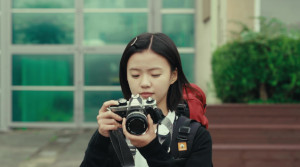
Story: Yeo-reum (Kim Si-a) lost her father a year ago and is still processing the tragic blow. There was nothing her father loved more in life than photography, and he also taught his daughter how to shoot pictures with analog cameras. Since her father's death, though, Yeo-reum has stopped taking pictures. Now, she is trying to get back into it and carries her father's camera with her everywhere, which still contains a roll of film her father loaded back when he was in school. Four shots are left on it, and one day, seemingly out of nowhere, her perfect subject appears before Yeo-reum: Yeon-woo (Yu Ga-eun). The girl is on the school's soccer team, and Yeo-reum is immediately drawn to her. Through her friend Min-jeong (Lee Eun-sol), the student finds out that Yeon-woo is actually interested in girls. Yeo-reum realizes that her feelings are of a romantic nature, and the soccer player seems to be interested in her as well. When Yeo-reum later has the film from the camera developed, she sees a few old pictures of her father, and one of them also features a boy. The girl finds this odd, since her father never took pictures of people. Even though twenty years have passed, Yeo-reum manages to track the man down, as a name tag is visible in one of the photos: Ma-roo (Kwak Min-gyu). Ma-roo now runs a barbershop, and when the girl tells him about her father's death, he is devastated. Yeo-reum is left wondering what kind of relationship this man had with her father ...

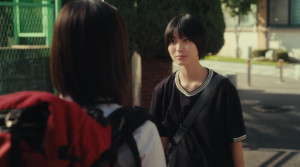
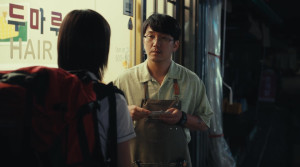
Review: After watching quite a few blockbusters recently, it was time again to give smaller films a platform. "Summer's Camera" is one such film, but it has also garnered a fair amount of buzz due to its presence at numerous film festivals. And it is immediately apparent why. First off, let me mention the concerns I initially had. Compared to the Western perspective, homosexuality remains somewhat of a taboo topic in Korea. Consequently, I feared that the way the subject was handled might feel a bit dated — family and friends ostracizing someone over their sexual orientation, a heavy-handed drama spotlighting social pressure, and so on. Much to my surprise, the film actually maintains an extremely positive tone and approaches the topic in a very natural, life-affirming way. A thumbs-up for that right off the bat. Furthermore, it helps that the story is told from the perspective of a teenage girl. Everything feels pure and unspoiled; Yeo-reum is simply figuring out who she really is, and that doesn't just reduce her to her sexual orientation — something that is unfortunately all too often the case with LGBTQ+ themed films. Thus, "Summer's Camera" already managed to win me over with this approach.

Unfortunately, I do have to strike a slightly more critical chord as well, because even though this is clearly a slice-of-life drama focusing on a girl coming of age, losing her father, and slowly discovering who she is, the film ultimately falls short of its potential. One example would be the titular camera. It might well be that this also refers to Yeo-reum herself (her name actually means "summer"); after all, she repeatedly hears the shutter of a camera in her head whenever she sees something beautiful that sparks something inside her — like the soccer player. Still, photographs also play an important role in the movie. These often look out of focus, at least the ones taken by the father, in an attempt to imitate something artistic, but as a narrative vehicle, they feel too timidly employed. It is peculiarly beautiful to see the glossy paper of photo prints; the tactile nature gives the medium an extra special touch, yet that alone is not enough.
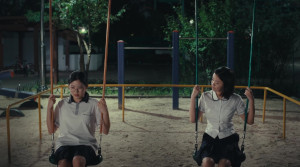
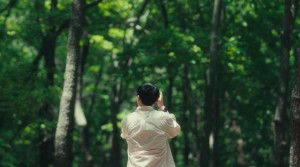
The core idea itself is fascinating. Yeo-reum discovers her sexuality, which, as previously mentioned, is received with ease by everyone around her. Even her father's relationship with another man, which comes to light very quickly, is presented completely unagitatedly, almost anticlimactically. Here, Yeo-reum's life is mirrored in her father's, and she finds comfort and understanding in Ma-roo. The barbershop becomes her secret sanctuary where she feels understood. We don't learn much about her mother; she appears briefly a few times, and it is obvious that she is still processing the pain of losing her husband. The daughter is also mature enough to understand this, which, of course, doesn't mean she can manage entirely on her own. She is, nonetheless, finding her own way to cope with life's adversities. Specifically regarding the handling of the past — the short flashbacks where the father is always only seen from behind, as if Yeo-reum couldn't yet muster the strength to remember his face — there are a few critical words to be said.
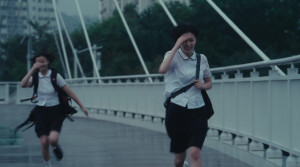
It's not that the director had to resort to photo collages or anything cheap to make the flashbacks more interesting, and "Summer's Camera" isn't a drama that would have benefited from major revelations or style over substance anyway; that said, the impression remains that it only scratched the surface. Naturally, this is also due to the runtime of just over 80 minutes. On the other hand, one can also be grateful that the film doesn't drag on unnecessarily, which is all too often the modus operandi for slow-burn dramas. In any case, one would have wished for far more backstory regarding the barber, even though it is understandable that director Divine Sung didn't want to overload her debut with overly complex characters right away, choosing instead to focus on Yeo-reum. The supporting characters, including the soccer player, are thankfully interesting enough that you find yourself wanting to know more about them. Ultimately, it is enough that the developments remain believable, especially in the relationship between the two girls, which is, partly by design, riddled with awkward moments that feel incredibly real for that exact reason.

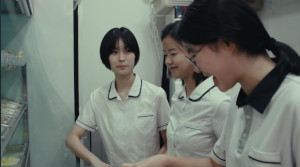
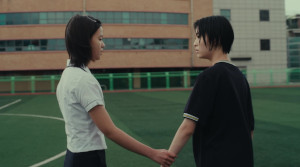
Kim Sin-ah ("Kill Bok-Soon") delivers an outstanding performance as the protagonist. She may appear reserved and passive at times, but not in the typical indie-drama way. She is full of life, curiosity, and drive, which one might not suspect at first. Because of this, the story manages to hit much closer to home than you would assume. At its core, after all, this is just a small slice of her life, and melodramatic scenes are entirely avoided. Visually, you don't even get the impression of watching an indie drama, though that is rarely the case nowadays anyway. The choice of songs and the soundtrack stand out as somewhat of a negative, as they feel a bit too cheerful and odd. "Summer's Camera" is undeniably a life-affirming drama that deals with sexuality and loss in a surprisingly calm manner, and it is precisely this quality that allows it to score positive points in an era where everything is told in a preachy, heavy-handed way. For that exact reason, I am willing to be a bit more generous with my rating, even though one must keep in mind that this film is fundamentally an indie drama and therefore cannot be recommended to everyone.





Disclaimer
