



Yomei Ichinen no Boku ga, Yomei Hantoshi no Kimi to Deatta Hanashi
Japan 2025
Genre:
Drama, Romance
Director:
Takahiro Miki
Cast:
Ren Nagase
Natsuki Deguchi
Mayuu Yokota
Kyoka Shibata
Ikuho Akiya
Rui Tsukishima
Toru Nakamura
Nene Otsuka
Kenji Mizuhashi
Yasuko Matsuyuki
Fumino Kimura
Kazuki Otomo
Atom Shukugawa
Toru Nomaguchi

Drawing Closer
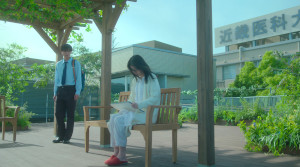
Story: Akito Hayasaka (Ren Nagase) is 17 years old and a talented painter. However, he is diagnosed with a tumor growing in his heart, which means he only has a year left to live. In the hospital, he goes up to the roof and considers ending his life. But then he sees a girl, Haruna Sakurai (Natsuki Deguchi), painting there. He strikes up a conversation with her and learns that she only has six months to live due to a rare disease. Akito is impressed by how calmly she deals with this news and becomes curious about her. He visits her again in the hospital and they slowly get to know each other. She wants him to enjoy his life to the fullest until old age. And so it happens that he cannot bring himself to tell her how little time he has left either. He finds out that the head nurse (Nene Otsuka) is her mother, who eventually asks him to continue visiting her daughter because she is showing joy in life for the first time in a long time. Akito also manages to track down a former girlfriend of Haruna's. He asks Miura (Mayuu Yokota) to get back in touch with Akito and put the incident that separated them behind them. Even though Haruna is summoning all her strength, her condition continues to deteriorate...




Review: It is difficult to criticize a romantic film for being overly dramatic and making most viewers cry endlessly when it is made clear right from the start that both (!) protagonists do not have long to live. Nevertheless, I must note that it is almost a little too much to include not only one terminal illness in a drama. Of course, the plot revolves around this very issue and attempts to work through the various aspects that arise from the fact that only Akito knows about the impending death of his potential love interest, while Haruna is unaware of the future demise of her new boyfriend. Nevertheless, the impression remains that the story tries to enhance the drama by simply doubling its quantity. As I said, it is made clear to the viewer from the very first second where the journey is headed, and “Drawing Closer” will appeal to all those who are enthusiastic about the genre. The film is well produced, the two leads deliver good performances, and the script is manipulative in exactly the way that is common in the genre in order to move the viewer to tears.
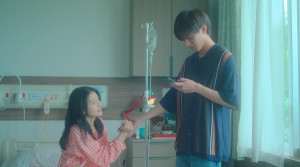
The one sitting in the director's chair is Takahiro Miki, who is more than familiar with the genre. His romantic drama “My Tomorrow, Your Yesterday” won me over with its fantasy twist and is one of my top 10 romantic films. This time, he takes a more classic approach, but adapts a novel by Aoi Morita, which is evident in the fact that he deals with some aspects that one might not expect in a film. For example, I was initially bothered by the fact that Akito's parents were given too little room in the story, only for them to be given a little more time on screen shortly afterwards. Too many characters wouldn't have been great, as the movie would have lost focus. Miura also appears relatively late in the story, but is bringing a breath of fresh air to the events and proving to be far more interesting and complex than one might initially think. The only thing that could have been better was Haruna's mother and how she deals with the situation.

One might assume that the film creates a predominantly somber mood, especially since the story takes place almost entirely in a hospital. However, as is typical for the director, the colors are vivid and the sun repeatedly breaks through the windows to convey a sense of hope — even though we know that nothing positive can be expected in terms of the story's outcome. Ultimately, though, it is also about making the most of the time we have and allowing love to develop even under the most adverse circumstances. The latter is not portrayed in an unbearably cheesy way, as one might expect. That is reserved for the drama and the finale. First, a friendship develops between the two terminally ill teenagers, which begins with Akito's curiosity about how Haruna can face death so joyfully. There is also a tragic story behind this, which is told in a short flashback. And, of course, everything is not quite as it seems. Akito, who has turned away from painting, rediscovers his calling and joie de vivre through the girl.
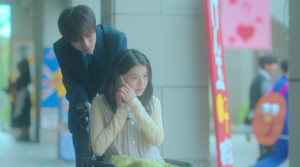
All of this is to be expected, but in order for no one to forget what is at stake, Akito collapses every now and then, and so his friends, who unfortunately get neglected by the script, also learn about his condition. He is only able to hide his illness from Haruna, even though he tries to tell her about it more than once. However, Haruna always interrupts him when he tries to confess his fate to her. One suspects that there is another twist behind this, and the film has quite a few of them. Sadly, none of them are unpredictable if you are even slightly familiar with the genre. Ren Nagase plays the boy who obviously grows through his friendship with the terminally ill girl. Natsuki Deguchi, on the other hand, succeeds in hiding some of her emotions as Haruna and living them out in a modified form, which then leads to a few eye-opening moments as the film progresses. Unlike “Your Lie in April”, which the film reminded me of in part because of its atmosphere (or perhaps because I don't know that many romantic dramas?), we are never left in any doubt that things will end quite tragically.
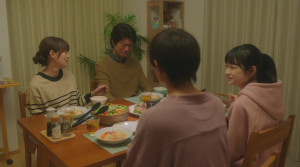
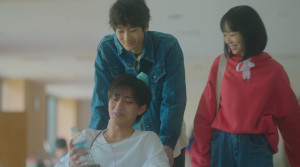

This naturally leads to the finale, which is peppered with countless tears and will more than satisfy (?) fans of the genre. Miura also enriches the film, allowing for a slight change of perspective. Still, you should be prepared for quite a bit of drama. Not everyone can tell the other person that they love them, and Akito, as the script requires, breaks down at the most impossible moments, resulting in at least two rather tragic situations, one of which seems particularly cruel and somehow doesn't fit into the film. Why? Because “Drawing Closer” is ultimately a drama that demands many tears, but also wants to be bittersweet. Above everything hovers hope and the message to enjoy life to the fullest in every second and to fight for every moment you can get. There's no question that those who are completely averse to the genre will find it difficult to get into the film, as it's all too obvious where things are headed. But fans of the genre will definitely find this a romantic drama worth watching.





Disclaimer
