



Rewrite
Japan 2025
Genre:
Sci-Fi, Romance, Drama
Director:
Daigo Matsui
Cast:
Elaiza Ikeda
Kei Adachi
Yuki Kura
Ai Hashimoto
Sayu Kubota
Reika Oozeki
Kasumi Yamaya
Oshiro Maeda
Kokoro Morita
Akari Fukunaga

Rewrite

Story: Miyuki Ishida (Elaiza Ikeda) is waiting for her younger self to appear at any moment, thereby completing the time loop. Ten years earlier, she had met a transfer student named Yasuhiko Sonoda (Kei Adachi). He had actually come from the year 2311, having invented a pill that allowed him to travel through time. He spent twenty wonderful summer days with Miyuki, during which the two engaged in various activities and grew increasingly close. Although he pretended not to know her very well while in class, he was all the more enthusiastic during their free time, savoring every minute spent with her. If classmates happened to spot them together, Yasuhiko could simply erase the memory of the encounter. Eventually, the day approached for the time traveler to return home; he told his girlfriend that he had chosen this small town for his journey because he had read about it in a book. To be precise, the book contains everything he has experienced. He therefore asks Miyuki to write the book so that he will travel to the past in the first place. Suddenly, however, an earthquake causes a building to collapse — the very building where Miyuki believes the boy to be. She has received a pill from him that allows her to travel ten years into the future for ten seconds. There, she meets her older self, who tells her that her boyfriend is fine and that she absolutely must write the book. Ten years later, she sits at home waiting for her younger self, intending to pass on those very words. But she does not appear ...


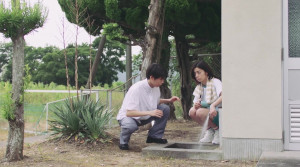

Review: A subgenre of time-travel fiction that is particularly popular in Japan is the time-loop story. Notable examples include "Beyond the Infinite Two Minutes", its spiritual successor "River" and "Mondays". And that is merely scratching the surface. "Rewrite" appears to tailor its narrative to romance enthusiasts, opening with an innocent, sweet love story that kicks off at a summer festival complete with fireworks; however, the romance burns out just as quickly, as the relationship is destined to last no more than twenty days. So, what happens next? Miyuki must somehow maintain the time loop. Yet, this is precisely where the first mysteries arise. Things are not as they initially seem, a situation that proves frustrating for our protagonist, while the audience, too, must contend with a narrative that toys with their expectations. This can be somewhat challenging in the case of "Rewrite2, as the focus does not always remain on our aspiring writer.

As is fitting for films of this genre, there has to be a major plot twist. It is well-executed and, more importantly, very welcome, given that the audience is kept in suspense for quite some time. Just as the pacing begins to drag because of this, the bigger picture unfolds. Still, some viewers might take issue with the role Miyuki plays within this complex web of relationships; without giving too much away, it is not as significant as one might expect. The ending, in particular, can even feel a bit like a letdown. On the positive side, I appreciated that the film is not simply a romance; that aspect quickly recedes into the background, not least because the protagonist is married now. Nevertheless, the flashbacks to their school days, and the coastal town setting in particular, evoke a pleasant sense of almost meditative warmth and nostalgia. Ultimately, Miyuki reconnects with several old schoolmates, and they reminisce about the past.
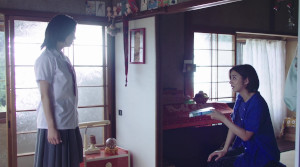
Yet, precisely those memories and characters that initially seem insignificant turn out to be vital pieces of the puzzle — at least in part — within the bigger picture; a picture that actually revolves around a time loop, though not quite the kind one might expect. It is a clever narrative device, and it hooked me immediately. However, there is no denying that the film loses its balance because Miyuki is relegated to the background, serving at times merely as the driving force of the evolving story and our anchor within it. Compounding this issue are certain complications arising from the time-loop premise that aren't handled particularly skillfully. We are all familiar with the rule about avoiding encounters with one's own self, but the way "Rewrite" handles this concept is anything but credible. Naturally, I cannot reveal too much here, but the level of planning required to avoid running into one's own past or future selves would be beyond human capability, making the whole scenario seem simply ridiculous.

Every now and then, before writing my own assessment of a film, I read other reviews - as is proper when aiming to provide a reasonably comprehensive picture of a cinematic work's pros and cons. In doing so, I noticed a point of criticism that I found understandable, even if it didn't weigh heavily for me personally. After all, one has certain expectations for a sci-fi film of this kind, including the expectation of a finale that offers some form of catharsis. "Rewrite" eschews this, though that is not to say it lacks a meaningful and satisfying resolution. The solution to the problem simply does not come from the direction one expected, or rather, not from the source the screenplay had led us to believe held all the answers. For me, this broke the predictable structure typical of such films and offered a welcome change of pace, especially since the protagonist had already receded into the background by that point. Still, it is a valid criticism that could dampen one's enjoyment of the story.



"Rewrite" is based on the novel of the same name by Haruka Hojo and features clear references to Yasutaka Tsutsui's "The Girl Who Leapt Through Time" — which, in my opinion, was unsuccessfully adapted as "Time Traveller: The Girl Who Leapt Through Time" (a film the anime is certainly superior to) — such as in the title Miyuki intends to give her novel. Initially, "Rewrite" presents itself as an intimate romance that feels innocent and pleasant, but it then shifts into a mystery story centered on why the time loop cannot be broken. As the story progresses, more characters are introduced - a process handled quite skillfully — though by the end, the film feels like a different movie entirely. The fact that this shift isn't too jarring is thanks to director Daigo Matsui, who establishes a distinctive and consistently coherent atmosphere through the coastal town setting and flashbacks to the characters' school days. "Rewrite" does struggle somewhat with its narrative, as the plot veers sharply in a new direction, and characters like Miyuki's husband and especially Yasuhiko could have benefited from more depth. All in all, as a fan of the genre, I was quite taken with "Rewrite", though, and most other sci-fi fans will likely feel the same way.





Disclaimer
