


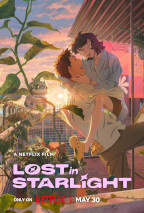
I byeol-e pil-yo-han
South Korea 2025
Genre:
Romance, Sci-Fi, Animation
Director:
Han Ji-won
Cast:
Kim Tae-ri
Hong Kyung
Kwon Yeong-mi
Kang Gu-han
Ahn Young-mi
Jang-mi
Yoon Ah-young

Lost in Starlight
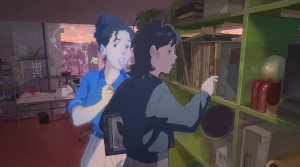
Story: It is the year 2051, and Nan-yeong (Kim Tae-ri) has but one wish: she wants to travel to Mars. Her motivation is to follow in her mother's footsteps. Over twenty years ago, her mother had been on Mars with a research team when an earthquake destroyed their research facility. To this day, Nan-yeong's father continues to scan space for radio signals from his wife, while Nan-yeong has become a researcher herself — working, among other things, on a method to automatically detect signs of life, such as microbes, on Mars. If she were to succeed in developing this equipment, she would stand an excellent chance of joining the next mission as an expert herself. Then, one day, due to a minor mishap, Nan-yeong accidentally drops an old record player onto the floor. Since the device was a gift from her mother, she visits various specialty shops in search of a place where it could be repaired. Just as she is on the verge of giving up, she runs into Jay (Hong Kyung) — who, as it turns out, actually knows his way around the device. He wants to get to know her better, but Nan-yeong puts up a barrier; after all, she is planning to head to Mars soon and cannot afford the "dead weight" of a relationship. Nevertheless, she eventually succumbs to Jay's charm...

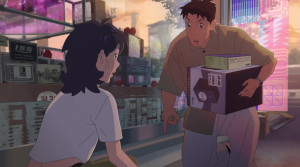
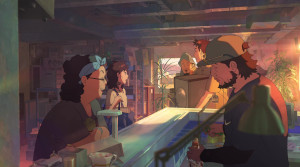
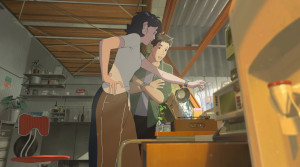
Review: What may have caught the eye of some readers of this website is the fact that there are hardly any reviews of animated films here. To be precise, the only one that comes to mind is "Appleseed", which I watched right around the time this website was born. The reason for this is likely self-evident. If I were to review every anime I watch — and admittedly, there aren't all that many of them — I would have to cut corners somewhere else. Furthermore, there are plenty of self-proclaimed anime experts out there who do a far better job of it than I do. Nevertheless, "Lost in Starlight" managed to catch my attention. The reason for this is twofold: for one, it is a Korean animated film distributed internationally on Netflix — which remains something of a rarity — and for another, its animation style stands out somewhat from the crowd. The fact that it is a science fiction film also contributed significantly to piquing my curiosity. However, it must be stated upfront that "Lost in Starlight" remains, first and foremost, a romantic drama. And coming from Korea, how could it be anything else?
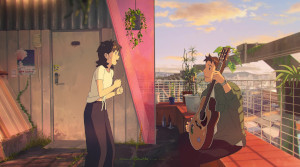
Science fiction is, in fact, ideally suited to the medium of anime. There is no need to spend millions on CGI — which, in a worst-case scenario, might end up looking like nothing more than a poorly animated afterthought in a mediocre, bombastic sci-fi blockbuster, anyway — and creators are free to give their imaginations full rein. It is precisely in the realm of inventiveness, though, that I had hoped for a little more; instead, we are presented mainly with familiar clichés: holograms, self-driving cars, drones and the like, the very things one would naturally expect to encounter in everyday life 25 years from now. Viewed in that light, perhaps one cannot really fault the creators. On the other hand, the story opens with Nan-yeong’s mother being on Mars, thereby establishing a technological setting that is clearly more advanced than our own present day. Nevertheless, the technology that is featured is realized with great visual flair. Particularly striking, and this may well be attributable to the story’s romantic core, are the vibrant colors, the azure skies, and the pristine streets, all of which lend the setting a distinctly utopian air.

As previously mentioned, the foundation of the story is a romance, one that is captured quite decently. It all feels a bit innocent perhaps, but not childish, a quality that ultimately proves appealing. Nan-yeong, in fact, has no desire for a relationship at all, as she has a clear goal firmly in her sights. To her, Mars is everything. The reasons behind this are revealed gradually, even if it is clear from the very beginning that she has not entirely overcome the trauma surrounding the loss of her mother. However, a bit more is indeed revealed in this regard later on. In any case, this leads to our protagonist being quite selfish. Her boyfriend means a great deal to her, just not quite as much as her lifelong dream. It is obvious from the outset that this is bound to become a major problem. Less clear, though, is the purpose served by the music in the film. While Jay is indeed a musician who has given up on his dream — and the screenplay’s intention to contrast his outlook on life with Nan-yeong’s is quite evident, as is the fact that Nan-yeong wants to encourage him to pursue his dream again — the whole subplot feels rather artificially constructed. This impression is only further reinforced during the finale, where we get the distinct feeling that this secondary storyline exists merely to inject a bit of extra drama and tension into the film.
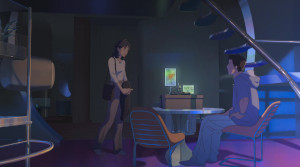
Nan-yeong is voiced by Kim Tae-ri, who has previously already appeared on-screen in the sci-fi genre, though her film "Space Sweepers" quickly faded into obscurity following its initial hype. It was, after all, simply popcorn cinema. The same cannot be said of "Lost in Starlight" and that's a good thing. While Kim Tae-ri does not always fully convince, particularly in the moments where she laughs, whereas Hong Kyung ("Good News") comes across as somewhat more natural, the film is primarily focused on its visuals, and in that regard, it certainly pleases. The animation itself is quite fluid, and it is said that certain scenes were even filmed with the actors as live-action scenes to help the animations become more natural. However, it is mainly the more imaginative sequences that truly impress. Every now and then, Nan-yeong is plagued by visions; furthermore, toward the film's conclusion, things take a somewhat surreal turn as the boundary between reality and imagination begins to blur. In these specific moments, the lovingly crafted animation and distinctive color palette truly come into their own.
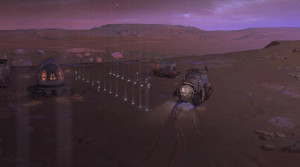
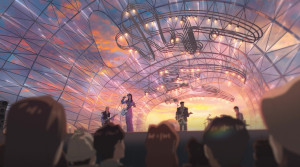
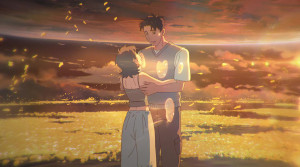
Through its animations and distinctive visual language, the film conveys a range of emotions, desires and hopes, sentiments that, in any other medium, would almost inevitably have come across as overly kitschy. "Lost in Starlight" is, without a doubt, a romance; yet, thanks to its medium and sci-fi elements, it successfully navigates the genre's worst pitfalls, breathing some fresh air into the world of romantic storytelling. Consequently, the film holds appeal even for those who typically have little use for love stories. Admittedly, as a sci-fi enthusiast, I might have wished for a bit more... well, sci-fi; nevertheless, the world feels vibrant and alive, not least thanks to its richly detailed and, at times, enchanting visuals. Furthermore, we have come to expect the same tragic finale involving plenty of tear-shedding from Korean dramas; yet, while the ending remains open to debate, it proved to be pleasantly surprising. The use of music as a stylistic device, along with Jay’s backstory involving his band, feels somewhat underdeveloped; despite this, however, the story still manages to strike all the right emotional chords. "Lost in Starlight" clearly has its heart in the right place; and even if it suffers from a few flaws, this animated feature — above all else thanks to its outstanding visuals — is well worth a recommendation.





Disclaimer
