



Hachi-ban deguchi
Japan 2025
Genre:
Horror, Thriller
Director:
Genki Kawamura
Cast:
Kazunari Ninomiya
Yamato Kôchi
Naru Asanuma
Kotone Hanase
Nana Komatsu

Exit 8

Story: A young man (Kazunari Ninomiya) is on his way to his part-time job and is standing on the train. Like everyone else, he's glued to his phone. Even when a mother's baby cries and one of the passengers yells at her, he pays no attention, just like the others. His ex-girlfriend calls, but he ignores the call. As he gets off the train, she calls again. She tells him she's in the hospital and has discovered she's pregnant. Now she wants to know what her ex-boyfriend thinks. He's having trouble deciding but insists on coming to the hospital. Just as his ex-girlfriend is about to tell him what she thinks about the situation, the call cuts off. The young man is making his way down the subway towards the exit, but he seems to be lost. Eventually, he realizes that the passage is repeating itself in an endless loop, and the same man (Yamato Kochi) keeps walking past him. When he speaks to him, the man doesn't react. Another time, he just grins at him like a madman. Finally, the young man notices an information panel on the wall. It tells you to continue going forward if everything is normal, but to turn back if you encounter an anomaly. After memorizing the layout of the corridor, the young man actually makes slow progress. He starts at Exit 0 and gradually sees signs with an ascending exit number. The anomalies are quite dangerous, however - and then a boy appears...

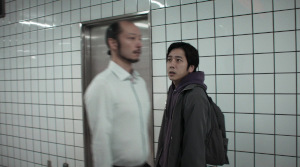

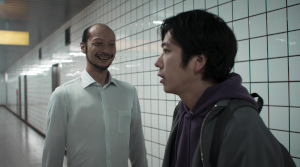
Review: First, I have to say that I haven't played the game by developer Kotake Create. The reason I wasn't even aware of its existence is likely that it's a walking simulator and the reviews were rather lukewarm, with the short playtime seeming to be a particular problem. The basic idea is based on a game that every elementary school child has played: you have to spot the differences in two pictures. A significant problem of the computer game also appears in the film adaptation. While it appears to be a horror film, genuine scares are rare. There are even a few scenes that manage to hit the right note in this regard, leaving one wishing for more of the same. In the end, "Exit 8" is more of a psychological thriller and seems quite aware of its own identity in terms of its story. For this reason, it's a work where the medium of film might even be the better choice for telling its story.
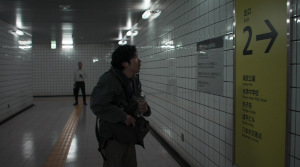
To absolutely no one's surprise, we have to deal with some repetitions here; after all, we're in a loop, even if this time it's not a time loop like in, let's say, "River", but one related to the location. And anyone familiar with Tokyo's underground system will quickly understand why it was chosen as the setting. After the first half hour, excluding the introduction, you get the impression that the pace slows down a bit too quickly and the repetitions offer hardly any surprises. Fortunately, the film does change perspective at one point and introduces a boy to further capture our attention. Somehow, though, I still wish the basic premise of the game had been developed a bit more. The viewer is hardly required to be active, because in the few instances where we notice something our protagonist doesn't, it's captured so obviously that you can hardly feel particularly observant or intelligent.

The protagonist of the story does the rest to make a bad impression. He's so incompetent and inattentive that you just want to scream at him in front of the screen. What's the point of him tediously listing the objects he sees, checking for any changes, when he keeps sticking to the same posters and doors he memorized at the beginning, even though there are countless other things that could show anomalies? He doesn't even care when he's obviously made a mistake and has to start from scratch. Kazunari Ninomiya ("Killing for the Prosecution") can't really come across as sympathetic in his role, which might also be related to the fact that our "hero" is already panting in panic from the very beginning — he has asthma, until suddenly it disappears later in the film —, dropping everything, or throwing himself hysterically on the floor and screaming. Sure, the nameless man is meant to be portrayed as an insecure loser, but this is a bit much. The introduction is intended to immediately evoke stress in the viewer, but this is attempted in a somewhat manipulative way, for example, when the ex-girlfriend's most important words are swallowed due to the poor connection.

Also quite irritating is the little boy who seems incapable of speaking and can't utter a word, even when he sees an anomaly. At the same time, one has to be annoyed with the adults who don't seem to care why the boy simply stands there silently. Another thing that angered me almost as much as the twentieth death against a boss in a Souls-like game (since we're on the subject of video games): Our hero stops curiously, watching what might happen, when he clearly hears something he's never heard before. As soon as you realize it's an anomaly, you'd think you'd turn right around! You wouldn't just stand there or even look into the room behind an open door! Yes, it's understandable that the director wanted to incorporate some horror into the film this way, or show how dangerous this "game" can be. But that can be done in a more subtle manner. As it is, you hardly feel any interest in seeing our hero survive.



Our protagonist repeatedly navigates the same corridors, seemingly without a single cut. This isn't entirely accurate, as we always have a good idea of where the cut occurred, but it's done so cleverly that, over a considerable period, the film still manages to create the impression of an endlessly long take. The story, which unexpectedly takes center stage as the film progresses through its 93 minutes, is truly compelling. There's also plenty to interpret, such as why the boy remains silent at the beginning. Naturally, the question is raised whether this could be purgatory or whether the protagonist needs to come to some kind of realization before he can escape this nightmare. The ending is quite ingenious, presenting the hero with two possible outcomes, keeping us on tenterhooks until the very last second, wondering which one he will choose. Ultimately, I quite enjoyed "Exit 8" because of its minimal yet significant story, which might be surprising given all the aforementioned shortcomings. However, those who are mainly looking for horror will certainly rate the film more critically.





Disclaimer
