



Konya, Sekai kara kono Koi ga Kietemo
Japan 2022
Genre:
Romance, Drama
Director:
Takahiro Miki
Cast:
Shunsuke Michieda
Riko Fukumoto
Kotone Furukawa
Honoka Matsumoto
Toru Nomaguchi
Maki Mizuno
Masato Hagiwara
Maho Nonami

Even if this Love Disappears from the World Tonight
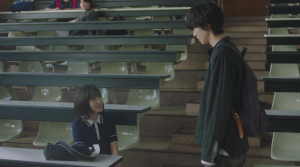
Story: Maori Hino (Riko Fukumoto) suffers from a rare form of amnesia since an accident nearly three years ago. Up until the accident, she remembers everything. Since then, however, she forgets every single day she experiences. Every morning she wakes up and has to reorient herself. A diary, which she writes in every evening, helps her with this. Only her parents and her best friend Izumi (Kotone Furukawa) know about her situation. One day at school, Maori is approached by a boy named Toru Kamiya (Shunsuke Michieda), who asks her if she wants to go out with him. He only asks her because some classmates want to have fun at his expense, and he hopes this will bring peace to a friend who's being bullied. Maori isn't aware of the circumstances but knows his declaration of love isn't serious. She agrees, though, because she thinks she should be able to enjoy life despite her circumstances. When she learns the reason for the boy's confession, it would be a little embarrassing if they "broke up" right away. So they pretend to be in a relationship, but Maori sets a few rules for the boy. The following days and weeks they spent together, and thanks to her diary, Maori can maintain the illusion of being a perfectly normal girl. Until she ultimately makes a mistake...

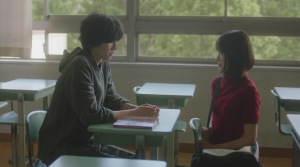
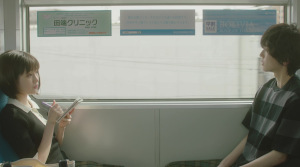
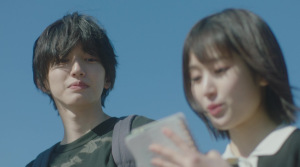
Review: I simply can't get into classic romance stories. I wouldn't even know what criteria to use to choose one, because to me, it seems like they all rely on the same clichés. But if a little fantasy or science fiction (or sometimes even humor) is added, it may pique my interest. With "Even if this Love Disappears from the World Tonight", I had hoped for similar originality to that of "My Tomorrow, Your Yesterday" and in that respect, I was both disappointed and satisfied. More on that later. The real reason I chose this film for the evening, however, was that a Korean remake had just been released on Netflix. I wanted to watch the original, based on a novel by Misaki Ichijo, but at the same time, I was somewhat forewarned about the direction this romantic film might take. After all, what does the Korean audience love more than anything else in a romance story? Right, a touch of tragedy. And that's precisely where my first criticism lies, because some things are quite transparent and a few of the plot twists are very predictable.

It begins with the fact that the main story is presented in a flashback. What's enjoyable about this is that the viewer has to figure out for themselves how the film jumps between the two timelines. At first, you might be a little confused, but it quickly becomes very easy to get your bearings, which speaks to the skillful direction. At the same time, the obvious question arises: Why doesn't Maori remember Toru? She writes about him in her diary every day and reads it every morning to recall her life from the previous days, even though "recall" is actually the wrong word, because she can't relive those moments in her memory. It's immediately noticeable that Maori writes in a handwritten diary, but later keeps it on a laptop. From this point on — and this happens very early in the story — it becomes clear what direction the romance is headed. The film also relies on clichés in several other ways; some scenes are even extremely familiar in this or a similar form. Whether that's the curse of the genre is debatable, but surprisingly, it doesn't make "Even if..." a bad film.
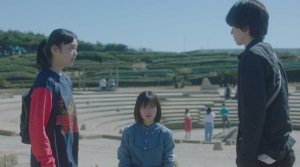
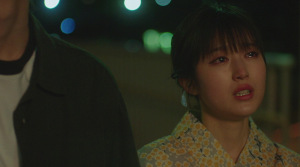
Need an example of a more than familiar scene? There's a scene where Maori, in a kimono, shares a beautiful moment with Toru at a fireworks festival. The third rule Maori establishes at the beginning is that they mustn't fall in love. And then there's the big surprise, which, strictly speaking, isn't one at all. Yes, that was more than one example, but it should temper expectations of consistently innovative genre fare. What makes the story so fascinating, besides the premise, are certain details that give the characters more depth and reveal that a novel served as its foundation. Toru struggles with an apparently irresponsible father who still hasn't gotten over his wife's death and wants to become a writer. The protagonist's sister has fled the family home but unexpectedly reappears. And with Maori, we at least get a brief glimpse of her parents having to have the same conversation with her every morning, yet despite this emotional strain, they remain patient and kind.
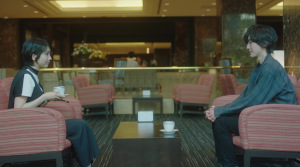
Furthermore, there's Izumi, who knows Maori's secret and initially seems to play only a minor role, but naturally takes on more and more prominence as the story progresses, becoming crucial to its development. The decisions she has to make are anything but small, and the moral dilemma that repeatedly comes to the fore is explored with surprising depth. The same applies to the question of whether Maori will ever regain her memories of Toru or whether she will have to continue "acquiring" them through diaries and video recordings. Especially towards the end — naturally with a considerable dose of drama — this is handled in a very mature and realistic way. These are the moments when "Even if..." clearly fights its way out of the mire of sentimentality and gains depth. Despite the predictable tragedy of the twist, which even invites eye-rolling, the ending left me feeling quite conciliatory. Overall, Maori's situation is simply unusual and leads to some funny and even frightening moments. The actors can contribute to making us warm to the individual characters, even if a little more depth in the character development department would have been nice.
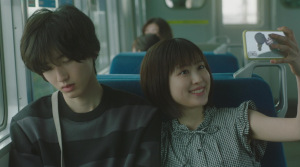
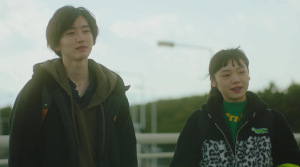
There are still many minor issues that bothered me: Toru immediately blurts out what's supposed to be a secret, and generally, people are very careless with keeping Maori's situation a secret. This doesn't feel realistic and seems to clumsily contribute to certain plot developments. Furthermore, one wonders how Maori copes with certain everyday moments. How, for example, does she manage at school or how does she plan to graduate? There are quite a few other questions, but these problems are far outweighed by an interesting story, beautiful moments, and the confident direction of Takahiro Miki, who has already proven with "Drawing Closer" that he can convey sentimentality without it becoming unbearable, while still leaving room for serious moments and emotions. Moreover, he dials back the kitsch in comparison. "Even if..." ultimately convinced me with its story and some fascinating questions that one inevitably asks oneself, thus allowing me to overlook the predictable drama.





Disclaimer
