


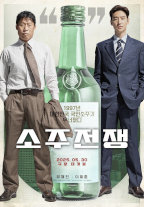
So-ju-jeon-jaeng
South Korea 2025
Genre:
Thriller, Drama
Director:
Choi Yoon-ji
Cast:
Lee Je-hoon
Yoo Hae-jin
Son Hyun-joo
Choi Young-joon
Byron Mann
Kim Ki-hae
Han Sang-jo
Yoon Ji-hye
Park Ji-il

Big Deal
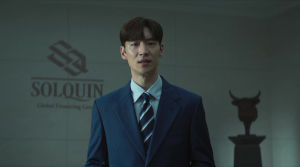
Story: In 1997, the Asian financial crisis has a firm grip on Korea. Gukbo, a long-established soju manufacturer, is facing serious trouble — largely because its boss, Seok Jin-woo (Son Hyun-joo), has driven a once-lucrative company to the brink of ruin through poor management. His direct subordinate, Pyo (Yoo Hae-jin), is tasked with finding a way out of the crisis alongside the consulting firm Solquin, as bankruptcy looms. Solquin’s head, Gordon (Byron Mann), dispatches his associate In-beom (Lee Je-hoon) — who hasn't been to Korea in ten years — to handle the matter. Pyo and In-beom get to know each other over a few drinks while exploring their options. Eventually, lawyer Yeong-mo (Choi Young-joon) is brought in; he succeeds in securing a court-ordered five-year deferral of payments to creditors for the soju manufacturer. Gukbo appears to be out of danger, but the consulting firm Solquin plans to buy up the soju company’s debt, currently traded as bonds, at a bargain price via a shell company; their goal is to eventually acquire the majority of the business through this debt and wrest control from Gukbo’s boss. Pyo is unaware that his new friend In-beom intends to set him up. Meanwhile, he has to deal with his boss, who is also buying up bonds — using a shell company registered in Pyo’s name — to avoid losing control of the firm to someone else. Five years pass, and the deadline for Gukbo to either repay its debts or file for bankruptcy approaches. Now, the real power struggle begins...

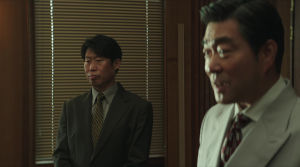
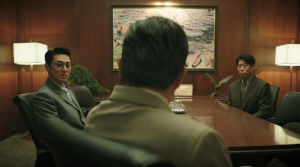
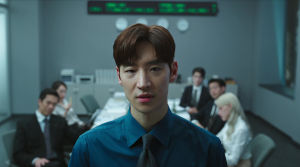
Review: When you really think about it, it is quite peculiar that there hasn't yet been a Korean film centered on the nation's favorite drink: soju. "Big Deal" takes a fascinating approach to this subject, one scripted by real life itself. The story revolves around the most famous brand of this alcoholic beverage, which faced bankruptcy during the Asian financial crisis despite having a rock-solid business. Naturally, the company in question is Jinro, though it has been renamed "Gukbo" in the film for obvious reasons. The narrative focuses on the strategic, political, and legal maneuvers employed by various parties vying to emerge victorious. South Korea has already produced a successful financial thriller dealing with the Asian crisis in the form of "Default", and last year, Herman Yau tackled the subject from a Chinese perspective in "A Gilded Game". However, "Big Deal" operates on a somewhat smaller scale, focusing on a specific company attempting to weather the financial crisis. That is not to say the events do not occasionally take on massive proportions; at its heart, though, the story remains somewhat more grounded.
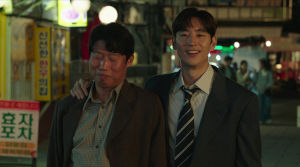
After these introductory remarks, it should be clear that "Big Deal" won't appeal to anyone who lacks at least some interest in business or political maneuvering. For me, the film's most fascinating aspect was the nuanced portrayal of the characters, specifically how they constantly test their own moral boundaries, crossing them or having a change of heart. Pyo, solidly played by Yoo Hae-jin ("Yadang: The Snitch"), is the character we most readily root for. He bears a heavy burden of responsibility and must constantly kowtow to a boss who makes questionable decisions and remains impervious to accusations, yet he is utterly devoted to the company. This is partly because he has nothing else left in his life; we briefly learn that his wife and child have left him. It would have been nice to learn a bit more about Pyo’s private life, as most details remain merely hinted at, but the film also deserves praise for avoiding a heavy-handed approach designed solely to wring a few tears from the audience. Ultimately, it is thanks to Pyo that we find ourselves siding with Gukbo.
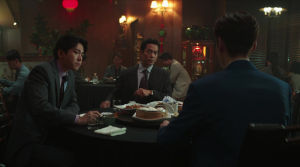
It is not actually all that easy to know whose side to take. The boss’s mismanagement is what put the company in jeopardy in the first place, and we learn that he is prone to using money — funds he ought to be using to repay creditors — to place private sports bets. Furthermore, he secretly buys back his own bonds because he is determined not to lose control of the company; in the end, his only concern is maintaining his own power. In doing so, he unwittingly shields himself from the very counterparty he assumes is there to help him. Byron Mann — likely still best known to most as Ryu from the 1994 live-action "Street Fighter" movie — delivers a fine, albeit undeniably cartoonish, performance as the "villain", yet his character still offers a few interesting facets. The thriller’s message is that in our world, the winners are those who know how to exploit every legal loophole, and that when it comes to making money, the method doesn't matter as long as it isn't officially illegal. In this way, "Big Deal" becomes a film that exposes and criticizes the Korean legal system of that era.
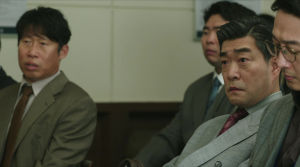
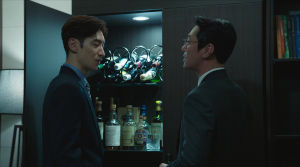
Hostile takeovers by foreign firms remain an issue, a point the film highlights at the end, but the nuanced portrayal of the parties involved, revealing that everyone has some dirt on their hands, makes it easier to take a side than if the film had simply lectured us or heavy-handedly vilified one party. In this regard, the role played by Lee Je-hoon ("Escape") is particularly compelling. Having spent so much time in the US, In-beom possesses a broader perspective and finds himself caught between cultures. Initially, it appears he intends to swindle Gukbo, and by extension, his new friend Pyo, but pangs of conscience eventually set in. As the story unfolds, his true intentions remain opaque to the viewer, as he wavers back and forth more than once. Yet, this is executed effectively, and the evolution of his character and mindset feels authentic. It would have been nice, though, if his brief acquaintance with Pyo, intended to provide the emotional foundation for events spanning five years, had received more attention; as it stands, the burden of imbuing that relationship with greater significance falls largely on actor Yoo Hae-jin.
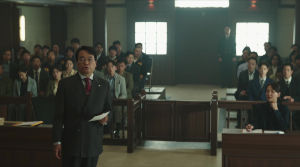

However, the story loses momentum a little past the halfway mark, something that seems almost typical for financial thrillers. The action shifts to the courtroom, and the strategic decisions can feel a bit dry as the two protagonists fade too far into the background; fortunately, this phase passes quickly, and the tension ramps up again. That tension stems largely from the fact that fraud and betrayal lurk around every corner. Thankfully, at 104 minutes, "Big Deal" avoids the trap of being unnecessarily long, a common issue with films revolving around the complex workings of the financial world. Moreover, despite certain details that might escape most viewers, the core story remains easy to follow without being oversimplified. Still, there is a minor issue with the ending, as it commits the cardinal sin of dragging on with too many epilogues. That said, the director does manage to include a scene shortly after the credits roll that neatly ties everything together. Anyone who has read this review to the end is likely interested enough in the subject matter to make "Big Deal" an easy recommendation. For the most part, the film successfully translates a complex story involving nuanced factions into an engaging experience. Furthermore, alongside the two leads, the supporting cast breathes enough life into the narrative to ensure the film never feels overly dry.





Disclaimer
