


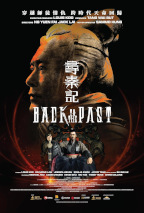
Xún Qín Jì
China 2025
Genre:
Action, Wuxia, Sci-Fi, Drama
Director:
Ng Yuen-fai
Jack Lai
Cast:
Louis Koo
Raymond Lam
Jessica Hsuan
Sonija Kwok
Joyce Tang
Bai Baihe
Power Chan
Michael Miu

Back to the Past
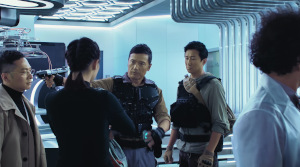
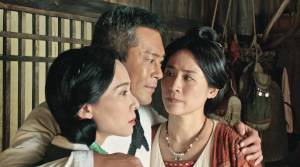
Story: Twenty-six years ago, Hong Siu-lung (Louis Koo) participated in a time travel experiment. His return journey failed, leaving him stranded in the Warring States period. There, he married two women and became a father. At the same time, he took Ying Ching (Raymond Lam) under his wing. Ying would later become Qin Shi Huang, the first emperor of China. Twenty years have passed since Hong was Ying's master, but he has continued to support him with advice and practical help. Hong wants the young king to unite the country and become emperor, even if it means numerous wars. The time traveler doesn't want to alter the course of history, as this could have catastrophic consequences. However, he is aware that the king has become increasingly cruel over the years, and so he has withdrawn with his family, fully expecting that Ying will eventually eliminate him. During the time travel experiment, the blame for the failure was wrongly placed on the inventor of the time machine, Ken (Michael Miu). After twenty years, Ken has been freed and, along with his daughter and a few mercenaries, takes possession of the time machine. He travels two thousand years into the past and intends to become emperor himself. His goal is to prove that history can indeed be changed. No one stands a chance against the newcomers and their futuristic weapons — only Hong may be able stop them.

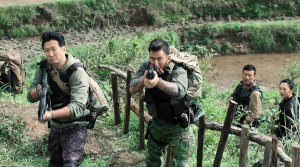
Review: I certainly won't pretend to be familiar with the 2001 TVB series "A Step into the Past", to which this film is a sequel. But you can think of it roughly as if there were a new "X-Files" movie today. Those unfamiliar with the original material will have no trouble following along, while fans will be hit with a serious dose of nostalgia. Among fans, there will be those who gratefully welcome the sequel, while others will criticize what exactly this has to do with the original, or how they could make such cheap sci-fi nonsense out of the great ideas of the past. Well, I certainly can't be sure with "Back to the Past", but interestingly, you can indeed see in many moments that the directors deliberately stir up nostalgia. And despite all the criticism I will get to shortly, there is no denying that the drama between the two protagonists works quite well, so that the relationship between the two can provide the foundation of the film.
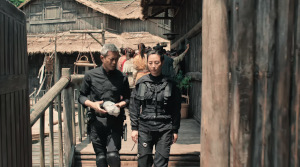
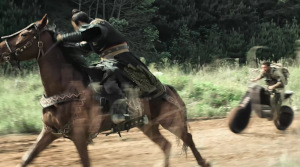
The recap of the story so far, along with a few later flashbacks, shows us the original TV series material. It becomes clear how much the two lead actors have grown over the past two decades. At the same time, it also becomes apparent that while "Back to the Past" has a significantly more polished look, its $45 million budget doesn't change the fact that it looks surprisingly cheap when it comes to special effects. There are constantly distracting green screens that make a chase across fields anything but believable, and aerial fights on hoverboards that, in theory, had potential, but unfortunately mostly come across as ridiculous. The blend of fantasy and science fiction should work well, but it's a fine line to walk to avoid unintentionally veering into comedy. In "Back to the Past" the directors unfortunately keep losing their footing. Moreover, one has to wonder where all the budget went when looking at the effects. Probably to the actors' salaries, especially since there are several cameo appearances or recurring roles from back then.
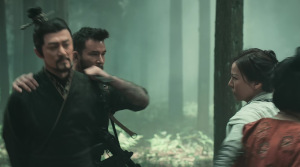
No one was expecting anything groundbreaking from the story, but at times, the filmmakers didn't even bother to give the characters any believable motivations. Ken is incredibly one-dimensional as the villain, a quality only the mercenaries can be even worse at, who — for whatever reason — also get a few moments on screen. The time-travel plot, about becoming the new emperor of China and thus proving that changing the past is possible, just feels flat. From a scientific and philosophical perspective (Is life and our biography predetermined and unchangeable?), this could have been something fascinating. Instead, we get a multitude of characters, a few of whom even seem quite promising. Sometimes, though, such a character disappears unspectacularly, while our hero, who previously had some nice moments with these personalities, dismisses it with a brief comment. There's simply no depth. It's as if the directors saved it all for the relationship between Hong and Ying. Because that one, at least, is a strong point.
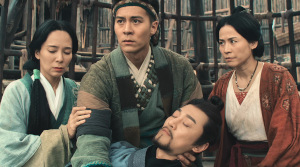
Perhaps I should preface my remarks with a small critique regarding this particular aspect of the story. Despite some very stereotypical portrayals of supporting characters, it seems the intention was to avoid a clear-cut black-and-white depiction. Ken has a daughter and wants to make amends, but chooses precisely the wrong path. Hong forgives far too easily and suddenly chats amicably with someone who was a villain just a minute ago. With other characters as well, the impression is given that the distinction between good and evil is quite chaotic in "Back to the Past". Still, and this is a positive development, things look quite different later on with Emperor Qin. He is anything but sympathetic and relentlessly ruthless. He is a victim of his own ambition to unify China, though, which he prioritizes above all else. Except, of course, for Ying, his former master. And so, he sometimes does things that make it seem as if there is still hope for him. Louis Koo and Raymond Lam also appeared together in "Twilight of the Warriors: Walled In" as quasi-mentor and student. This time, however, they clearly have more on-screen chemistry, and it's evident that they carry shared joy and baggage from a past relationship.
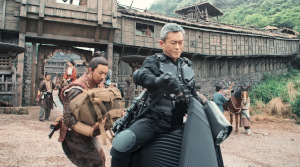
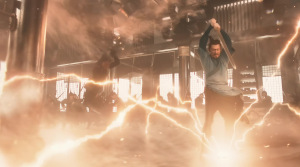
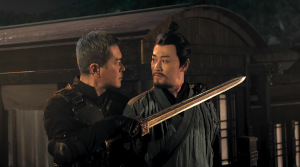
Ultimately, this leads to a surprisingly poignant finale, in which both actors deliver strong performances, precisely because they convey complex emotions through subtle acting, allowing us to grasp the intricacies of their complicated relationship. This makes it easier to forgive a few of the humorous scenes at the beginning, which don't always land, and especially the B-movie sci-fi clichés. One can't help but wonder if we're in an alternate 2025, given the time machine, motorcycles that unfold from a small puck, and cell phones with year-long batteries. The true nature of "Back to the Past" becomes clear when the credits roll, revealing a very extensive alternate ending that feels like nothing more than fan service and has the feel of a typical Lunar New Year film. In the end, I even enjoyed "Back to the Past" a little, but the action, despite Sammo Hung as choreographer, is very disappointing, and the story is shallow. It's a wild ride that will deliver too little for most, even though an interesting relationship is at its heart.





Disclaimer
