


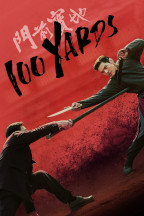
Men qian bao di
China 2023
Genre:
Action, Drama, Comedy
Director:
Xu Haofeng
Xu Junfeng
Cast:
Jacky Heung
Andy On
Bea Hayden Kuo
Tang Shiyi
Li Yuan
Kevin Ridger

100 Yards
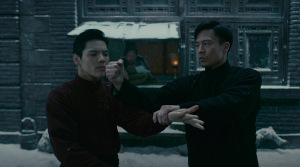
Story: It is 1912, and Tianjin has changed drastically due to contact with the West. However, martial arts schools still exist, maintaining law and order in their neighborhood. One of these schools is run by an old master who is now seeking a successor. He wants his star pupil, Qi Quan (Andy On), to take the reins, but Qi is challenged by Shen An (Jacky Heung), the master's son, when Shen returns to the school after having been away for years. Qi emerges victorious, but the master suddenly dies. The martial arts school council is now certain who should be the master's successor: Qi Quan. This presents a major problem for Shen An, who thus repeatedly causes trouble and tries to provoke Qi into another duel. When the council's chairwoman is then shot dead in the street, the question arises: which party is responsible? Qi wants to bring in more and more students from outside, including Westerners, which doesn't sit well with everyone on the council, while Shen is determined to fight for his rightful place. They eventually agree to another duel, but both Qi and Shen have heard of a secret weapon technique belonging to the master, which they believe their opponent may have secretly learned. The two therefore seek out Gui Ying (Tang Shiyi), who is said to have learned this technique from the school's master. However, Xia isn't very helpful...

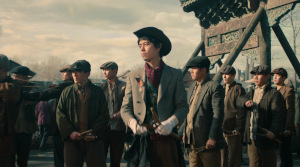
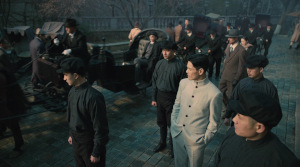
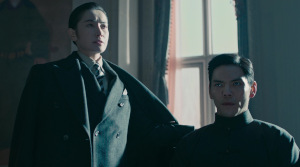
Review: Tianjin in the 1910s isn't exactly my favorite time period for kung fu films, perhaps because the strong contact with the West somewhat dilutes Chinese culture, and the core of most films revolves around precisely this cultural contact as well as corrupt Chinese officials, behind whom lurks an even more evil Westerner. But a predictable plot doesn't have to be a major drawback if the action is good. Surprisingly, "100 Yards" is structured quite differently in terms of story. There are two protagonists who are in competition with each other and both want to lead the same school. The appeal of the story lies in the fact that we can hardly identify a clear villain. Both characters have their dreams and desires and act accordingly — sometimes in a rather ruthless manner. Thus, the question of who deserves our sympathy swings wildly back and forth at the beginning, until we realize that we have to accept we are dealing with two people who both have their weaknesses and unpleasant sides. This really appealed to me. However, the film has flaws in other respects that simply didn't make the movie work for me personally.
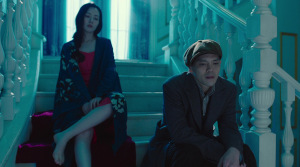
Let's briefly discuss the characters. Andy On ("Blind War") is undoubtedly an action star who can deliver in his field. He also possesses the most charisma in "100 Yards", but aside from the praise he receives for being given a morally ambiguous character, his portrayal lacks genuine depth. Qi Quan's relationship with Gui Ying — actress Tang Shiyi even steals the show in her scenes at times and also impresses on the action front — shows promise and hints at some good ideas, but ultimately isn't used enough to add more layers to the characters. Jacky Heung, as the second and ultimately the main protagonist, presents the real problem. He fails to display the necessary charisma or screen presence to carry the story. Perhaps the script is partly to blame, because his character, like the entire story, has a few peculiarities that didn't work for me.
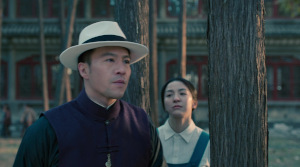
The balance between underworld factions, schools that uphold law and order, masters who are betrayed – there's plenty of material that evokes familiarity and initially draws you into the film. But this kung fu drama also boasts a few unique features that each viewer will have to decide for themselves, what to make of it. First and foremost, there's the tone of "100 Yards". The sets are sometimes quite colorful, while at other times gray clouds hang in the sky. It's almost as if the directors couldn't decide between lightheartedness and gloom. And this also applies to the choice of genre. Because for me, it wasn't always clear whether we were watching a comedy or a drama. There are simply a few extremely absurd scenes that made little sense to me, even if that might have been the intention. For example, at one point, Shen An's (ex-)girlfriend rides by on a bicycle – dressed as a mail carrier – and pulls Shen out of a fight. Why do the thugs let her do this? Because nobody messes with the mail carrier! There may be more background information that makes it seem less ridiculous, but it remains one of the many strange moments.
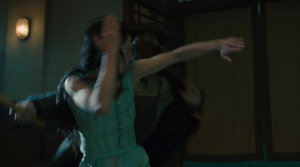
What really bothered me, however, were the scenes where the characters behaved as if they were in a kindergarten. Perhaps a few words about the film's direction are in order before addressing this. Xu Haofeng and Xu Junfeng love to hover with the camera over the scene, moving from one face to the next. This creates moments where someone has to wait until the camera lingers on their face before they start speaking. There are also other scenes reminiscent of a theatrical performance, featuring acting that would fit into that medium — and not in a good way. Someone falls theatrically to the ground, others stand around awkwardly, and so on. These moments make some things unintentionally comical, or even make you wonder if a comedy was even intended. But then the individual parts of the film simply don't mesh well. It becomes downright frustrating when you realize that some of the visuals look like the directors were trying to create art-house cinema. Unfortunately, this also includes the unrealistic behavior of some people. So you try to interpret something grand behind all of this, but are left empty-handed in the end.
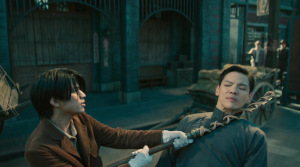
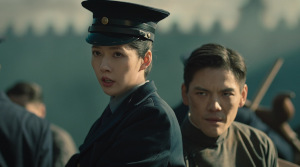
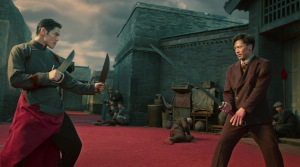
The music also has some peculiarities. For the most part, we hear a Western-inspired soundtrack, then there are melodies that would be more at home in a horror film, and the whole thing is topped off with a healthy dose of jazz. In this regard, there's another irritating scene at a party where we see an orchestra playing in the background, leading us to assume the music we're hearing is theirs. Stylistically, though, it doesn't fit at all, and we even hear some instruments that aren't in the orchestra! The sound design also takes some peculiar liberties. Sometimes you hear a drawn-out noise, like an electric car driving by – whatever that's supposed to mean. Okay, of course, there's also a fair amount of kung fu, and I mean a lot. Numerous fight scenes are nicely distributed throughout the film and technically well-executed. They didn't exactly blow me away, but they're what might make "100 Yards" interesting for kung fu enthusiasts despite all the criticism. Unfortunately, the atmosphere, which simply doesn't know where it wants to go, didn't appeal to me, which is why I can't recommend this kung fu drama.





Disclaimer
